

The Weekly Wealth Watch
June 15, 2026
The Markets
“Investing is about finding opportunities and having the patience and discipline to let them develop over time.” — Abigail Johnson, (Fidelity Investment)
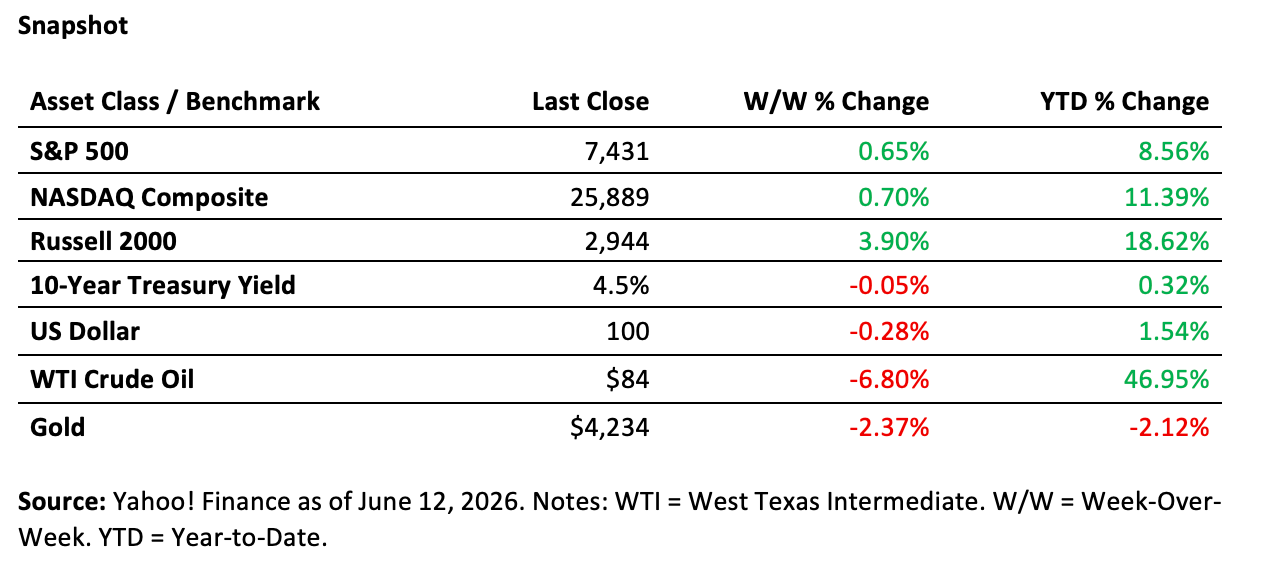
U.S. equity markets continued to move higher this week, supported by improving market breadth and renewed participation from smaller companies. The S&P 500 gained +0.65%, lifting its year-to-date return to +8.56%. Technology shares also advanced, with the NASDAQ Composite rising +0.70%, extending its year-to-date gain to +11.39%. The Russell 2000 was the week's standout performer, surging +3.90% and increasing its year-to-date return to an impressive +18.62%. The strong performance from small-cap stocks suggests investors are becoming more comfortable broadening risk exposure beyond the market's largest companies.
In fixed income, the 10-Year Treasury yield declined –0.05%, finishing the week at 4.5%. The modest decline in yields provided a supportive backdrop for equities and helped ease pressure on interest-rate-sensitive sectors.
Currency markets softened slightly, with the U.S. dollar declining –0.28%, though it remains positive for the year at +1.54%. The weaker dollar offered a modest tailwind for both domestic and international risk assets.
Commodities moved lower during the week. WTI crude oil declined –6.80%, though it remains significantly higher for the year at +46.95%. Meanwhile, gold fell –2.37%, pushing its year-to-date return into negative territory at –2.12%. The weakness across both energy and precious metals suggests investors were rotating away from some defensive and inflation-sensitive positions as confidence in risk assets improved.
Taken together, the cross-asset landscape remains constructive. Equities moved higher across all major benchmarks, Treasury yields eased, the dollar softened, and small-cap stocks continued to outperform. While commodity markets experienced a pullback, broader market participation and resilient equity performance suggest investors remain focused on growth opportunities and improving economic fundamentals.
Consistent with Abigail Johnson's perspective, this week's market action reinforces the importance of patience and discipline. Leadership continues to broaden, and investors who remain focused on long-term opportunities rather than short-term noise have been rewarded throughout the year.
Space: The Final Frontier
"The important achievement of Apollo was demonstrating that humanity is not forever chained to this planet." — Neil Armstrong
Separating Orbit from Hype
With the potential SpaceX IPO dominating investor conversations, it feels like everyone suddenly became an aerospace engineer, venture capitalist, and rocket scientist all at once.
The excitement is understandable. SpaceX isn't just building rockets. It's building a communications network, a satellite infrastructure business, a potential AI enabler, and perhaps one of the most important pieces of next-generation global connectivity. Starlink has already become SpaceX's largest reported revenue driver, and the company continues to invest aggressively in expanding bandwidth, reducing latency, and improving mobile connectivity. But investing is rarely as simple as identifying a great company.
As legendary economist John Maynard Keynes famously warned: “Markets can remain irrational longer than you can remain solvent.”
The Valuation Gravity Problem
Many investors may gain exposure through funds or SPVs (Special Purpose Vehicles), which can introduce additional complexity, fees, and even exposure dilution as new money flows into those vehicles. Then comes the valuation question. Some analysts look at current financials and believe the valuation is too high. Others assume future AI demand, satellite communications, and global connectivity justify almost any price. The truth—as is often the case in investing—probably lies somewhere in the middle.
Perhaps the most fascinating wrinkle is how index providers may treat a future IPO. Nasdaq's methodology could potentially allow earlier inclusion into the Nasdaq-100, while S&P Dow Jones continues to maintain its traditional seasoning requirements. That divergence could create competing narratives between investors seeking early exposure and those willing to wait.
"The only way of discovering the limits of the possible is to venture a little way past them into the impossible." — Arthur C. Clarke
For investors, the challenge is not determining whether SpaceX is an extraordinary company. The challenge is determining how much of that extraordinary future is already reflected in today's price.
Human Interest
The Kids Are Looking Up Again
A recent trend has educators smiling: more young students are expressing interest in becoming engineers, programmers, roboticists, and astronauts.
For decades, children dreamed of becoming athletes, actors, or musicians. Today, many are dreaming about Mars, artificial intelligence, and building the technologies that may define the next century.
Perhaps that shouldn't surprise us.
When humanity pushes boundaries, imagination tends to follow.
As former President John F. Kennedy reminded us:
"We choose to go to the Moon not because it is easy, but because it is hard."
The next generation may not see space as science fiction. They may simply see it as another frontier waiting to be explored.
Progress Over Perfection
“The best way to predict the future is to invent it.” — Alan Kay
Markets often become obsessed with perfection. Every earnings report must beat expectations. Every new technology must transform the world overnight. Every innovative company must justify its valuation immediately. Reality rarely works that way.
The story surrounding SpaceX is a reminder that some of the most transformative businesses in history were never linear. Railroads, automobiles, aviation, the internet, and smartphones all experienced periods of skepticism, setbacks, and growing pains before becoming part of everyday life.
Today's excitement around artificial intelligence, satellite communications, and next-generation connectivity may ultimately follow a similar path. The future may arrive more slowly than enthusiasts expect, but often faster than skeptics believe.
SpaceX's reported agreements tied to AI infrastructure, combined with Starlink's growing connectivity business, illustrate how innovation frequently requires significant upfront investment before financial rewards become fully visible. Investors should remember that large capital expenditures can create tremendous long-term value, but they can also pressure margins and profitability in the near term.
Innovation Is a Journey
“Software is eating the world.” — Marc Andreessen
The lesson for investors is simple: successful investing is rarely about finding perfection. It is about identifying businesses, technologies, and trends that are steadily moving in the right direction.
Today, AI, connectivity, and space infrastructure may be the next chapters of that story.
Markets don't need perfection.
They simply need progress.
Fun Facts & Figures
“The future belongs to those who see possibilities before they become obvious.” — John Sculley
🚀 A Falcon 9 rocket costs roughly 90% less to launch than many comparable rockets from two decades ago.
📡 Starlink is now the largest satellite constellation in history, with thousands of satellites orbiting Earth and providing internet access across much of the globe.
🌍 More than 2.5 billion people still lack reliable internet access. For companies like SpaceX, that represents both a challenge and a potential market opportunity.
💰 A single percentage point change in a company's growth assumptions can sometimes alter valuation estimates by billions of dollars. That's why valuation debates around innovative companies can become so heated.
🛰️ Light travels from the Earth to the Moon in about 1.3 seconds. A round-trip conversation between Earth and Mars, however, could take anywhere from 6 to 44 minutes depending on planetary positions.
📈 The Nasdaq-100 and S&P 500 may not treat future IPOs the same way. Nasdaq's methodology could allow certain large companies to enter the index much sooner than traditional S&P eligibility rules permit.
🤖 Artificial intelligence data centers consume enormous amounts of electricity. Some estimates suggest a single advanced AI facility can require as much power as a small city.
On This Day in History – June 15
“The farther backward you can look, the farther forward you are likely to see.” — Winston Churchill
The Magna Carta Changes History
On June 15, 1215, King John of England agreed to the Magna Carta, one of the most influential legal documents ever written.
While originally intended to resolve disputes between the king and rebellious barons, its legacy became much larger. The Magna Carta established the principle that no ruler is above the law—a concept that would eventually influence democracies around the world.
More than 800 years later, its impact can still be seen in constitutional governments and legal systems globally.
Every giant leap starts with a countdown.
Other June 15 Milestones
✈️ 1916 — Boeing was founded, helping shape the future of aviation.
⚡ 1752 — Benjamin Franklin's famous kite experiment helped demonstrate the electrical nature of lightning.
🌋 1991 — Mount Pinatubo erupted in the Philippines, producing one of the largest volcanic eruptions of the 20th century.
Sources & Footnotes:
- User-provided research memorandum, Space: The Final Frontier.
- Nasdaq, Nasdaq-100 Index Methodology FAQ (May 2026).
- S&P Dow Jones Indices, Treatment of MegaCap Companies Consultation Results (June 2026).
- Via Satellite, SpaceX's IPO Filing Gives First Look Into Company's Financials (May 2026).
- TechCrunch, Google Will Pay SpaceX $920 Million Per Month for Compute (June 2026).
- Axios, Anthropic Is Paying SpaceX $15 Billion Per Year (May 2026).
- EchoStar Investor Filing Regarding SpaceX Spectrum Transaction.
- T-Mobile, T-Satellite with Starlink Service Overview.
- British Library and National Archives UK, historical records regarding the Magna Carta (1215).
- WCG Research & Analysis, June 2026.
Disclosures:
·
- Securities offered through LPL Financial, Member FINRA/SIPC. Investment Advice offered through WCG Wealth Advisors, LLC, a Registered Investment Advisor. WCG Wealth Advisors, LLC is a separate entity from LPL Financial.
- Bond yields are subject to change. Certain call or special redemption features may exist which could impact yield. (118-LPL)
- The S&P 500 is a stock market index tracking the stock performance of 500 of the largest companies listed on stock exchanges in the United States. Indexes are unmanaged and cannot be invested in directly. (102-LPL)
- The NASDAQ Composite Index measures all NASDAQ domestic and non-U.S. based common stocks listed on The NASDAQ Stock Market. The market value, the last sale price multiplied by total shares outstanding, is calculated throughout the trading day, and is related to the total value of the Index. Indexes are unmanaged and cannot be invested in directly. (112-LPL)
- The fast price swings in commodities will result in significant volatility in an investor’s holdings. Commodities include increased risks, such as political, economic, and currency instability, and may not be suitable for all investors. (122-LPL)
- There is no guarantee that a diversified portfolio will enhance overall returns or outperform a non-diversified portfolio. Diversification does not protect against market risk. (26-LPL)
The Russell 2000 Index is generally representative of the 2,000 smallest companies by market capitalization in the Russell 3000 index, which represents approximately 10% of the total market capitalization of the Russell 3000 Index. Indexes are unmanaged and cannot be invested in directly. Bonds are subject to market and interest rate risk if sold prior to maturity. Bond values will decline as interest rates rise. Bonds are subject to availability, change in price, call features and credit risk. The fast price swings in commodities will result in significant volatility in an investor’s holdings. Commodities include increased risks, such as political, economic, and currency instability, and may not be suitable for all investors.
Securities offered through LPL Financial, Member FINRA/SIPC. Investment Advice offered through WCG Wealth Advisors, LLC, a Registered Investment Advisor. WCG Wealth Advisors, LLC is a separate entity from LPL Financial.